
How SEO Helps Local Businesses Grow
Imagine you run a local boutique coffee shop, a family-owned plumbing business, or a neighborhood dental practice. For decades, your growth relied on a few predictable channels: word-of-mouth recommendations, a listing in the local yellow pages, maybe a flyer dropped in community mailboxes, or a physical sign hanging above your storefront.
This is where Local Search Engine Optimization (SEO) comes into play. For local businesses, SEO isn’t an elite corporate marketing strategy reserved for global brands with million-dollar budgets. It is a highly accessible, practical tool that levels the playing field, allowing a neighborhood shop to outrank massive national chains right in their own backyard.
In this comprehensive guide, we will break down exactly how SEO drives real, measurable growth for local businesses, how search engines evaluate your local presence, and how you can claim your share of local search traffic.
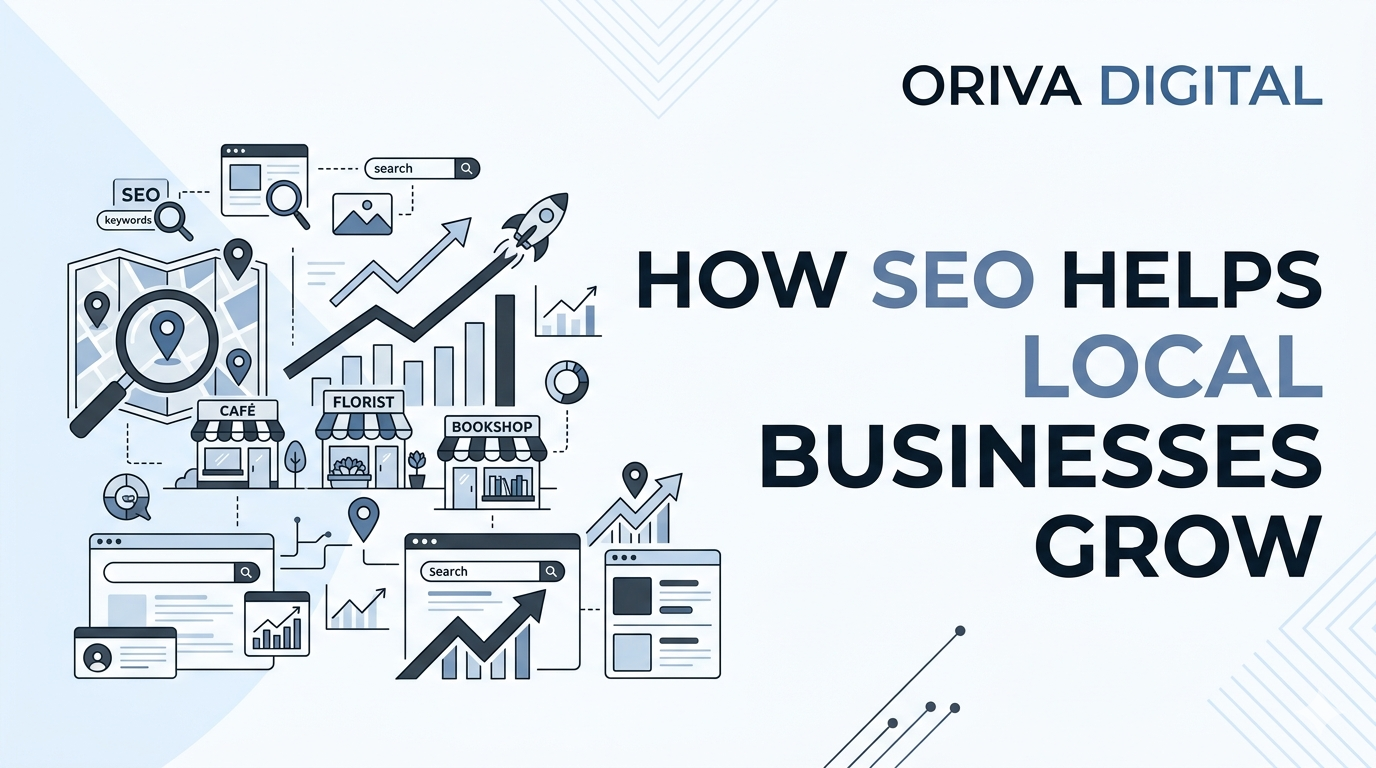
Understanding Local SEO: The Digital Main Street
To understand how SEO helps you grow, you first need to understand how search engines handle local intent. Google and other search engines are smart enough to realize when a user is looking for a physical service or a nearby establishment.
If you search for “how to fix a leaky faucet,” Google will show you articles, video tutorials, and step-by-step guides. The search engine assumes you want to learn how to do it yourself. However, if you search for “faucet repair,” the search engine interprets this as a local commercial request. Instead of informational articles, it populates a map alongside a list of three local plumbing businesses operating in your immediate area.
This specific block of local map results is known in the digital marketing world as the Local Map Pack or the 3-Pack.
Securing a spot in this Local Map Pack is the holy grail of local marketing. Why? Because it appears above the standard organic search results, pulling the majority of clicks and phone calls from users who need a solution immediately.
Local SEO is the intentional process of optimizing your online footprint so that search engines recognize your business as the most relevant, reliable, and convenient answer to a local query. While having social media accounts is great for building community, your website and local search presence are what capture high-intent buyers. If your digital foundation isn’t built yet, you may want to start by exploring Why Every Small Business Needs a Website in 2026.
The Three Pillars of Local Search Ranking
Search algorithms look at hundreds of distinct factors to determine which local businesses deserve to be featured at the top of the page. Fortunately, you don’t need to memorize a complex algorithm. For local businesses, the ranking factors boil down to three simple pillars:
1. Proximity
How close is your physical business location or defined service area to the person executing the search? Search engines want to provide the most convenient option possible. While you cannot change your physical address to match every user, you can ensure that search engines understand your exact location and the precise neighborhoods you serve.
2. Relevance
How well does your business match what the user is looking for? If someone searches for a “gluten-free bakery,” and your website simply says you sell “baked goods,” a search engine might skip over you in favor of a competitor who explicitly details their gluten-free menu items. Relevance is built through clear, descriptive web copy and thorough business listings.
3. Prominence
How trustworthy and well-known is your business online? Search engines measure prominence by looking at your digital reputation. This includes the quantity and quality of your online customer reviews, how many other local websites link back to yours, and whether your business information is consistent across the web.
Practical Examples: The Customer Journey in Action
Let’s step away from technical definitions and look at two realistic business scenarios to see how a strong local SEO setup directly translates into customer acquisitions.
Scenario A: The Urgent Repair Need
Consider a homeowner who wakes up at 6:00 AM on a freezing winter morning to discover their home’s furnace has broken down. They are cold, stressed, and need a technician immediately. They search “heating repair near me” on their phone.
Company A has a stunning website but has never touched their local SEO. They don’t appear on the map, and their contact information is hidden on a sub-page.
Company B has invested in local SEO. They appear as the second listing in the Local Map Pack. Their phone number is visible directly on the search results screen, their business hours confirm they are open, and they have forty 5-star reviews praising their quick response times.
The homeowner doesn’t spend time browsing portfolios; they tap Company B’s phone number straight from the search screen. By 7:30 AM, a technician is at their door. Local SEO didn’t just gain Company B a click; it gained them an immediate, high-ticket service job.
Scenario B: The Weekend Discovery
Now, consider a resident who just moved to a new neighborhood and is looking for a boutique fitness studio. They aren’t in a rush, so they search “yoga classes [neighborhood name].”
They browse the map results and click through to a local studio’s website. Because the studio optimized their site with clear class schedules, localized descriptions, and transparent pricing, the user finds exactly what they need within two clicks and books an introductory pass. For businesses just beginning to wrap their heads around these concepts, starting with a foundational Beginner’s Guide to SEO for Small Businesses is an excellent way to map out this consumer path.
The Tangible Benefits and Business Impact of Local SEO
When you invest your time or marketing budget into optimizing for local search, the returns extend far beyond simple web traffic. Local SEO actively reshapes the economics of your small business.
High-Intent Traffic Means Higher Conversion Rates
Traditional advertising channels, like local radio spots or social media ads, are disruptive. They display your business to people who might be watching a video or listening to music, meaning most of those people have zero immediate need for your service.
Local search traffic is entirely different. It is pull marketing rather than push marketing. When someone searches for a local service, they are actively raising their hand and stating an immediate need. This high-intent traffic converts into actual phone calls, walk-ins, and contact form submissions at a significantly higher rate than almost any other marketing channel.
A Sustainable, Cost-Effective Long-Term Asset
Paid advertising campaigns on Google or Facebook are transactional: the moment you stop paying for ads, your lead stream drops to zero. Local SEO, however, is a long-term investment that compounds over time.
Once your website ranks well organically and your Google Business Profile has built a strong library of positive reviews, that visibility stays there. It continues to drive daily customer inquiries for months or even years without requiring you to pay for individual clicks. It essentially acts as a permanent, high-performance salesperson for your brand.
Building Hyper-Local Authority and Trust
Consumers inherently trust search engine rankings. Subconsciously, when Google places a local business at the top of the map pack, users view that business as an industry leader. Combined with a consistent stream of genuine customer reviews, a strong local search presence establishes your business as a trusted fixture within your geographic community.
At Oriva Digital, we frequently collaborate with local service providers and small businesses to construct digital growth strategies that stand the test of time. We routinely witness local companies achieve sustainable independence from expensive paid ad networks simply by optimizing their local search infrastructure and capturing organic local demand.
Actionable Tips to Kickstart Your Local SEO Strategy
You don’t need to rewrite your entire website code today to start seeing improvements. Here are four practical, high-impact steps you can implement this week to boost your local search footprint:
1. Claim and Optimize Your Google Business Profile
Your Google Business Profile (formerly Google My Business) is the single most important asset for local SEO. It is completely free to set up.
Ensure your business name is your real operating name—do not artificially stuff keywords into it.
Select the most accurate primary category for your business (e.g., choose “Italian Restaurant” instead of just “Restaurant”).
Add high-resolution photos of your workspace, your team, and your completed projects.
2. Standardize Your NAP Consistency
NAP stands for Name, Address, and Phone number. Search engines crawl thousands of local business directories (like Yelp, YellowPages, TripAdvisor, and local chambers of commerce) to verify your business details. If your address is listed as “123 Main Street” on your website but “123 Main St.” or an old address on Yelp, search engines see this inconsistency as a red flag. Ensure your NAP data is identical across every platform on the internet.
3. Create a System for Customer Reviews
Reviews are a core ranking signal for prominence. Don’t leave reviews to chance. Train your team to send a polite follow-up email or text message immediately after a successful service delivery, providing a direct link to your Google review page. Always reply professionally to every review you receive, whether it is a glowing compliment or constructive criticism.
4. Build Localized Website Content
If you serve multiple towns or neighborhoods, don’t just list them in a single paragraph at the bottom of your homepage. Create dedicated service area pages. For instance, if you are a painter based in one city but serve three adjacent towns, build individual pages detailing your painting services tailored to each specific community.
Common Mistakes to Avoid in Local SEO
Many small businesses accidentally sabotage their local rankings by falling into predictable traps. Keep these pitfalls in mind as you build out your strategy:
Ignoring Negative Reviews: Leaving a critical review unanswered looks bad to both potential customers and search engine crawlers. Address issues calmly, offer a resolution, and show the community that you care about customer satisfaction.
Neglecting the Multi-Channel Approach: While search traffic is exceptionally powerful, it shouldn’t exist in a vacuum. Integrating your local web strategy with social media helps validate your brand’s authority. For additional perspective on balancing these platforms, take a look at our curated Social Media Tips for Local Businesses.
Using a P.O. Box for Local Listings: Search engines require a legitimate physical address or a clearly defined residential service area boundary. Attempting to use UPS store locations or P.O. boxes to trick the system into thinking you have an office in a neighboring town will result in your business profile being suspended.
Conclusion
The physical marketplace has permanently shifted to the digital screen. Local SEO is no longer a luxury or an optional addition to your marketing toolkit; it is the primary engine that drives modern neighborhood discovery, foot traffic, and service inquiries.
By taking control of your Google Business Profile, maintaining uniform business information across the web, earning authentic customer feedback, and structuring your website around local intent, you build an organic pipeline of customers who are actively searching for your expertise.
Navigating the technical side of local search optimization while managing the daily demands of a growing business can be a tough balancing act. If you want to stop guessing at keywords and build an airtight, professional local search campaign, the team at Oriva Digital is here to help you guide the way. We specialize in turning local visibility into tangible business revenue, ensuring your business stands out exactly where your customers are looking. Reach out today to discuss how we can map out a localized growth plan for your brand.